F1 Cost Cap Explained: What the $215m Limit Covers
Follow 2026 F1 rules UpdatesFollow updates
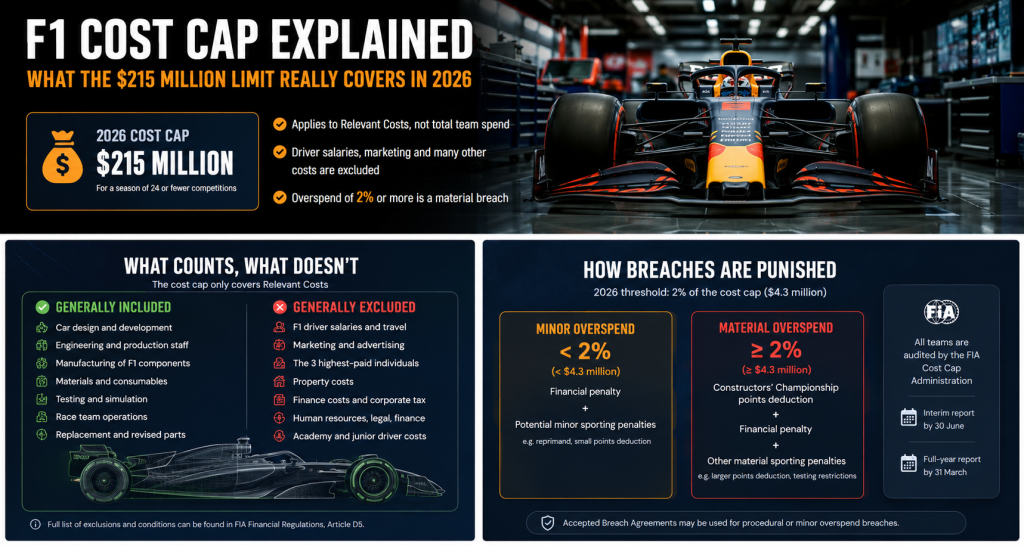
Formula 1 teams are not limited to spending only $215 million in total during 2026.
That figure is the sport’s cost cap, but it applies to a defined group of expenses known as Relevant Costs. Driver salaries, marketing, property costs and several other major areas are excluded from the calculation.
This distinction matters because the F1 cost cap is often described as though it represents the complete annual budget of a Formula 1 team. It does not.
The regulations instead control much of the money used to design, manufacture, test and race the cars, while allowing teams to spend outside the cap in specifically defined areas.
The 2026 regulations also tighten the consequences of overspending. An overspend of 2% or more is now classed as a material breach, compared with the 5% threshold under the 2025 rules.
What is the F1 cost cap?
The F1 cost cap is a regulatory limit on certain costs incurred by or on behalf of a Formula 1 team during a calendar year.
According to the FIA’s 2026 Formula 1 Financial Regulations for F1 Teams, it applies to costs connected with operating an F1 team, including developing, manufacturing, testing and racing its cars.
Teams remain free to choose how they allocate their resources within the cap. The FIA does not tell a team that it must spend a specific amount on its floor, front wing, suspension or next year’s car.
Instead, each team has to decide how much of its available financial room should be directed toward areas such as:
- Current-car upgrades
- Development of the following season’s car
- Engineering and production staff
- Manufacturing new and replacement components
- Running the cars throughout the season
- Reliability improvements
- Contingency for accidents and unsuccessful upgrades
The FIA identifies three broad objectives for the financial regulations:
- Promoting a more competitive championship
- Protecting sporting fairness
- Supporting the long-term financial stability of Formula 1 teams
The regulations are also intended to preserve Formula 1’s engineering and technological challenge rather than turning the championship into a completely standardised competition.
What is the 2026 F1 cost cap?
For a season containing 24 competitions or fewer, the 2026 Formula 1 cost cap is:
$215 million
Where more than 24 competitions take place, the cap rises by $1.8 million for every additional competition.
| Competitions held | Cost cap |
|---|---|
| 24 or fewer | $215,000,000 |
| 25 | $216,800,000 |
| 26 | $218,600,000 |
| 27 | $220,400,000 |
One important change from the previous framework is that the base amount is not reduced when fewer than 24 competitions take place. The $215 million figure applies whether the season contains 24 races or fewer.
Indexation begins under the new framework for the reporting period ending in 2027. The published $215 million amount is therefore the starting point for the 2026 financial-regulation cycle.
Try the F1 cost-cap calculator
Use the calculator below to model the competition count, planned Relevant Costs, committed spending and remaining headroom in a hypothetical team budget.
Currency note: the live currency selector provides a current-market conversion for readers. Official FIA compliance uses fixed Presentation Currency rates, which are explained later in this article.
On A Flying Lap Calculator
F1 Cost Cap Scenario Calculator
Cap assumptions
Team spending scenario
This educational tool is independently produced by On A Flying Lap. It is not an official FIA, Formula 1 or team calculator and should not be treated as financial, legal or regulatory advice.
For a standalone version, open the F1 Cost Cap Scenario Calculator.
Why did the headline cost cap rise from $135 million to $215 million?
The published base figure increased by $80 million between the 2025 and 2026 financial frameworks.
That does not mean teams suddenly received another $80 million to spend on exactly the same activities.
The 2025 FIA Financial Regulations used a $135 million base for 21 competitions. The amount was increased or reduced by $1.8 million for each race above or below that reference number.
The 2026 system starts at $215 million for 24 or fewer competitions, but it also changes the perimeter of exclusions and financial adjustments.
When the new rules were approved, the FIA explained that the effective level of the cap remained broadly equivalent to the previous framework. The larger published number reflects cumulative inflation and changes to which costs are excluded or adjusted.
The FIA’s explanation can be read in its World Motor Sport Council regulation update.
In plain English, the accounting boundary changed.
Comparing $135 million directly with $215 million without considering the new exclusions and adjustments creates the misleading impression that teams were simply handed an additional $80 million of development freedom.
Why the cost cap is not an F1 team’s total budget
The cost cap applies to Relevant Costs, not every dollar spent by the wider Formula 1 business.
A team may spend money on excluded activities without reducing the amount of cap space available for regulated car development and operation.
This is why a Formula 1 organisation can still have:
- A large marketing department
- Expensive hospitality operations
- Highly paid drivers
- A heritage-car programme
- Commercial and licensing divisions
- Road-car or non-F1 engineering projects
- Major property and facility expenses
while remaining within the FIA’s cost cap.
It also explains why comparing a team’s company revenue directly with the $215 million limit does not tell us whether the team is compliant.
Revenue, total expenditure and Relevant Costs are three different figures.
Readers can explore the difference between income sources using our F1 Team Revenue Mix Calculator.
What generally counts toward the F1 cost cap?
The regulations begin with the total costs incurred by the team’s Reporting Group. Specific exclusions are then removed and prescribed financial adjustments are applied.
In broad terms, ordinary costs involved in developing, building, testing and racing the Formula 1 cars generally count unless a specific exclusion or adjustment applies.
This can include:
- Car design and aerodynamic development
- Engineering work on current and future cars
- Manufacturing Formula 1 components
- Most ordinary engineering and race-team employee costs
- Materials and consumables used for car production
- Testing and simulation work
- Formula 1-specific factory operations
- New, revised and replacement car components
- Preparation and operation of the race cars
The exact treatment can depend on accounting rules, inventory timing, shared facilities, related-party transactions and whether an activity also serves a non-F1 purpose.
For example, an engineer working exclusively on the Formula 1 car is different from an employee dividing time between F1 and a separate engineering project. A mixed-use cost may require a supportable allocation rather than being fully included or fully excluded.
What is excluded from the F1 cost cap?
The exclusions are considerably broader than driver salaries.
Article D5 of the 2026 Financial Regulations identifies numerous costs that must be removed from the Relevant Cost calculation, although many remain subject to definitions, evidence requirements and financial limits.
Marketing activities
Costs directly attributable to marketing activities are excluded.
This allows a team to build its brand, create advertising campaigns, activate sponsorships and engage with fans without automatically reducing its regulated car-development allowance.
That does not mean every branded or public-facing expense is automatically excluded. The activity must still meet the regulatory definition of marketing.
F1 driver pay
The consideration paid to an F1 driver is excluded, together with the driver’s travel and accommodation costs.
A team signing a more expensive driver therefore does not automatically lose an equivalent amount of car-development budget.
The contract still affects the wider business, cash flow and profitability. It simply does not form part of the Relevant Cost calculation.
Other racing drivers and academy programmes
Qualifying costs connected with other racing drivers are excluded, including their consideration, travel and accommodation.
Costs directly attributable to managing and operating an academy programme are also excluded.
This gives teams room to support junior drivers without placing the full academy operation inside the Formula 1 car budget.
The three highest-paid qualifying individuals
The cost of the three highest-paid qualifying individuals who do not already fall under another exclusion may be removed from Relevant Costs.
These people are not automatically the Team Principal, Technical Director and CEO. The exclusion is based on the three highest aggregate qualifying amounts recognised during the reporting period.
Associated employer social-security contributions, travel and accommodation for those individuals are also covered by the exclusion.
Finance costs and corporate income tax
Finance costs and corporate income tax are excluded.
This prevents different borrowing structures, funding arrangements or tax positions from directly determining how much regulated car-development spending a team is permitted.
Human resources, finance and legal activities
Costs directly attributable to human-resources, finance and legal activities are excluded.
The work actually performed remains important. A job title alone may not be enough where an employee carries out a mixture of excluded and Formula 1 development activities.
Property costs
Defined property costs are excluded from Relevant Costs.
However, equipment, capital projects, depreciation, maintenance and mixed-use facilities can have separate treatments. It would therefore be too broad to say that every cost associated with an F1 factory automatically sits outside the cap.
Employee bonuses
Employee bonus costs may be excluded, but only within a prescribed maximum.
For 2026, the exclusion is limited to the lower of:
- 20% of Total Fixed Employee Remuneration
- The indexed Excluded Bonus Maximum
This prevents teams from moving unlimited employee remuneration outside the cap simply by describing ordinary pay as a bonus.
Other notable exclusions
The regulations also contain exclusions or conditional treatments covering:
- Heritage-car activities
- FIA entry and participation fees
- Driver Super Licence fees paid to the FIA
- FIA fines and financial penalties
- Foreign-exchange gains and losses
- Mandatory employer social-security contributions
- Specified competition and current-car testing travel
- Parental and adoption leave
- Certain indefinite sick or disability leave
- Sustainability initiatives
- Health and safety costs
- Specified catering services
- Certain business-continuity and disaster-recovery costs
- Defined power-unit supply costs
Each exclusion has its own wording and conditions. The fact that a category appears in Article D5 does not mean every expense with a similar name can automatically be removed.
Search the F1 cost-cap inclusion checker
Use the checker to search common expenses such as driver pay, marketing, crash damage, employee bonuses, factory energy and related-party transactions.
On A Flying Lap Reference Tool
F1 Cost Cap Inclusion Checker
This checker is an educational summary. The official definitions, allocations, adjustments and Cost Cap Administration determinations control the actual treatment.
The checker is also available on its own page: F1 Cost Cap Inclusion Checker.
Can a team move spending into another company?
A team cannot legally avoid the cost cap simply by moving Formula 1 work into another company within the same corporate group.
The regulations use a concept known as the Reporting Group.
The named Formula 1 team is included first. Where that team has incurred less than 98% of the costs of its F1 activities, additional companies within the same legal group must be added until at least 98% of those costs has been captured.
Costs incurred elsewhere in the group may also have to be recharged to a Reporting Group entity or added to Relevant Costs through a regulatory adjustment.
This is particularly important for:
- Manufacturer-owned Formula 1 teams
- Teams using shared corporate facilities
- Sister-team relationships
- Engineering subsidiaries
- External manufacturing operations
- Customer-team and component-supply arrangements
Related-party and inter-team transactions may have to be valued using prescribed methodologies rather than whatever invoice amount the participating companies choose.
A team cannot simply sell itself an expensive Formula 1 component for a token amount and expect the artificial invoice price to determine its cost-cap treatment.
How are different currencies handled?
Each team reports its Relevant Costs in an approved Presentation Currency.
For 2026, the FIA regulations publish the following illustrative equivalents for a season containing 24 competitions or fewer:
| Presentation currency | Official 2026 cost-cap amount |
|---|---|
| US dollars | $215,000,000 |
| Pounds sterling | £170,090,000 |
| Euros | €198,663,000 |
| Swiss francs | CHF 189,992,000 |
These figures use the FIA’s fixed Initial Applicable Rates:
- 1 pound sterling = 1.2640 US dollars
- 1 euro = 1.0822 US dollars
- 1 Swiss franc = 1.1316 US dollars
For other currencies, the regulations specify a historical Federal Reserve-based calculation around 29 February 2024.
This means a live exchange-rate conversion can help readers understand the current market value of $215 million, but it is not the conversion used to judge a team’s compliance.
Can an F1 team save unused cost-cap room for the following year?
Not without limits.
From the reporting period beginning in 2027, a team may choose to make a downward adjustment equal to its Unused Cost Cap Amount from the preceding year, subject to a maximum of $2 million before applicable indexation.
The amount is not simply whatever the team believes it saved.
It must be determined by the Cost Cap Administration after reviewing the previous year’s Reporting Documentation and Reassessed Relevant Costs.
This means the new framework allows a limited amount of unused cap space to benefit the next reporting period, but it does not allow a team to bank an unlimited underspend for future seasons.
Three lesser-known cost-cap adjustments
More than six Sprints
If more than six Sprint events take place during the reporting period, the regulations provide for a $300,000 downward adjustment in Relevant Costs for each additional Sprint.
A downward adjustment reduces the amount counted as Relevant Costs. It does not represent a direct cash payment to the team.
2027 and 2028 power-unit integration work
The regulations contain specific adjustments connected with future power-unit updates and integration with the chassis.
For the 2026 and 2027 reporting periods, teams must allocate a total downward adjustment of $3 million across the two years. The team may choose the proportion, subject to the prescribed declaration process.
Unused cap room from 2027
The limited $2 million unused-cap adjustment begins from 2027 and is based on the previous reporting period’s FIA-reviewed position.
These adjustments demonstrate why the published cost-cap number is only the starting point. The final Relevant Cost calculation also depends on regulatory exclusions and prescribed upward or downward adjustments.
How does the FIA check team spending?
Teams do not wait until the end of the year and submit one unsupported total.
The 2026 framework includes both interim and full-year reporting.
Interim reporting
The interim reporting period runs from 1 January to 30 April.
The normal deadline is 19:00 CET on 30 June, or the next business day where 30 June is not a business day, unless the Cost Cap Administration communicates a later date.
Full-year reporting
The full-year reporting period runs from 1 January to 31 December.
The normal submission deadline is 19:00 CET on 31 March of the following year, or the next business day where applicable, unless a later deadline is communicated.
The full-year submission includes:
- Reporting Group documentation
- Full-year financial reporting documentation
- Formal declarations
- An assessment report from the approved independent audit firm that signs the team’s audited annual financial statements
The declarations must be signed by the Team Principal, CEO, CFO and Technical Director. The team’s Ultimate Controlling Party must also confirm the full-year Reporting Group documentation.
Teams must retain relevant documents, accounting records and employee emails for the previous five financial-regulation reporting periods.
The FIA Cost Cap Administration can request information, investigate suspected non-compliance, use independent auditors and refer cases to the Cost Cap Adjudication Panel.
The scale of this work should not be underestimated.
When the FIA completed its review of the 2024 financial submissions, it said the process had taken seven months.
Nine teams were found fully compliant. AMR GP Limited was found to have committed a procedural breach, but the FIA confirmed that it had not exceeded the cost cap.
That example is important because a procedural breach and an overspend breach are not the same thing.
What is an Accepted Breach Agreement?
An Accepted Breach Agreement, usually shortened to ABA, allows the Cost Cap Administration and a team to resolve certain breaches without a complete adjudication hearing.
An ABA may be offered for a procedural breach or a minor overspend breach.
To enter into the agreement, the team must:
- Accept that it breached the Financial Regulations
- Confirm that it provided full disclosure
- Accept and satisfy the sanctions or monitoring conditions
- Pay the costs specified in the agreement
- Waive its right to appeal or otherwise challenge the ABA
The FIA publishes a summary identifying the breach, sanctions and enhanced monitoring arrangements while protecting confidential information.
A material overspend breach or qualifying non-submission case must instead be referred to the Cost Cap Adjudication Panel.
What happens if an F1 team breaks the cost cap?
The regulations recognise several different categories of non-compliance.
Procedural breach
A team can commit a procedural breach without exceeding the cost cap.
Examples may include inaccurate, incomplete, misleading or late documentation, failure to submit interim reporting on time, or failure to cooperate properly with the Cost Cap Administration.
A procedural error is therefore not automatic evidence that the team spent more than it was allowed.
Minor overspend breach
A minor overspend occurs when the team’s Relevant Costs exceed the cap by less than 2%.
On a $215 million cap, 2% is:
$4.3 million
An overspend of less than $4.3 million is therefore minor in regulatory classification, assuming the unadjusted $215 million cap applies.
That does not mean the breach is treated as insignificant.
Where the Cost Cap Adjudication Panel determines that a minor overspend occurred, it must impose a financial penalty and any other appropriate minor sporting penalties.
Material overspend breach
A material overspend occurs when the team exceeds the cap by 2% or more.
Where a material breach is confirmed, the Cost Cap Adjudication Panel must impose:
- A Constructors’ Championship points deduction
- A financial penalty
- Any other appropriate material sporting penalties
| Breach classification | 2026 threshold on a $215m cap |
|---|---|
| Minor overspend | Less than $4.3 million |
| Material overspend | $4.3 million or more |
Potential sporting penalties
Depending on the category and circumstances of a breach, the available penalties can include:
- A public reprimand
- Constructors’ Championship points deductions
- Drivers’ Championship points deductions
- Suspension from specified stages of a race weekend
- Restrictions on aerodynamic or other testing
- A reduction in the team’s future cost cap
- Suspension from complete competitions
- Exclusion from the championship for a specified period
- Enhanced financial monitoring
The exact sanction depends on the breach, its scale and the aggravating or mitigating factors involved.
Does the F1 cost cap make every team equal?
No.
The cap limits spending within a defined area, but it does not give every team identical facilities, knowledge, personnel or efficiency.
Teams still differ in:
- Wind-tunnel quality
- Simulation accuracy
- Existing factory equipment
- Recruitment strength
- Technical leadership
- Manufacturing speed
- Existing intellectual property
- Commercial income
- Parent-company support
- Organisational efficiency
A team that uses $200 million efficiently can outperform a rival that reaches the full limit without finding productive development directions.
The financial regulations reduce the ability of the wealthiest teams to overwhelm their rivals through unrestricted spending. They do not remove the value of better engineering and better decisions.
This is where the cost cap connects directly with Formula 1’s aerodynamic testing restrictions.
Teams must manage both the amount of development work they are allowed to conduct and the money available to turn that development into real components.
Read our complete guide to F1 wind-tunnel rules and aerodynamic testing allowances, or compare the positions directly with the F1 Aerodynamic Testing Allowance Calculator.
The big picture
Formula 1’s $215 million cost cap is best understood as a regulated development and operating allowance, not the total price of running a team.
The headline figure tells only part of the story.
What matters is the boundary between Relevant Costs, exclusions and financial adjustments—and how well a team allocates the money that does count.
For fans, this changes the way upgrades and team performance should be viewed.
A new floor, front wing or suspension package is not only an engineering decision. It is also a financial choice made against every other component the team could develop during the same season.
That is what makes the cost cap so influential.
It does not tell teams what to build.
It limits how many expensive mistakes they can afford to make.
Continue exploring F1’s rules and finances
- F1 Cost Cap Scenario Calculator
- F1 Cost Cap Inclusion Checker
- F1 Wind Tunnel Rules Explained
- F1 Team Revenue Mix Calculator
- F1 Calculators and Reference Tools
Check for updated regulations: Visit the FIA Formula 1 regulations library.
About The Author

Covering Formula 1 news, race analysis, driver stories and the bigger talking points around the sport.
Latest F1 News