F1 Wind Tunnel Rules Explained: 2026 Testing Limits
Follow aerodynamic testing restrictions UpdatesFollow updates
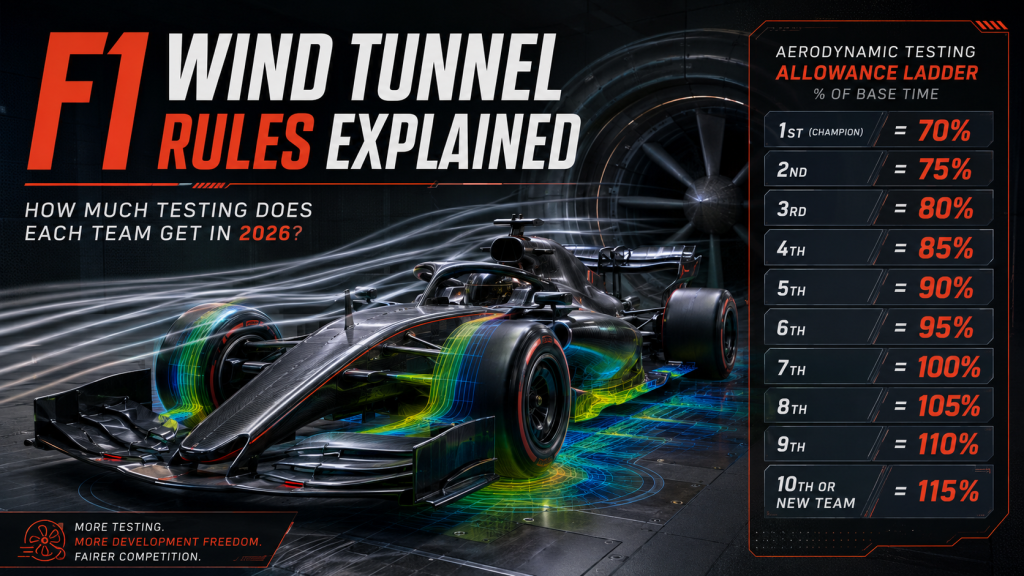
Formula 1’s fastest team does not receive the most time to develop its car.
It receives the least.
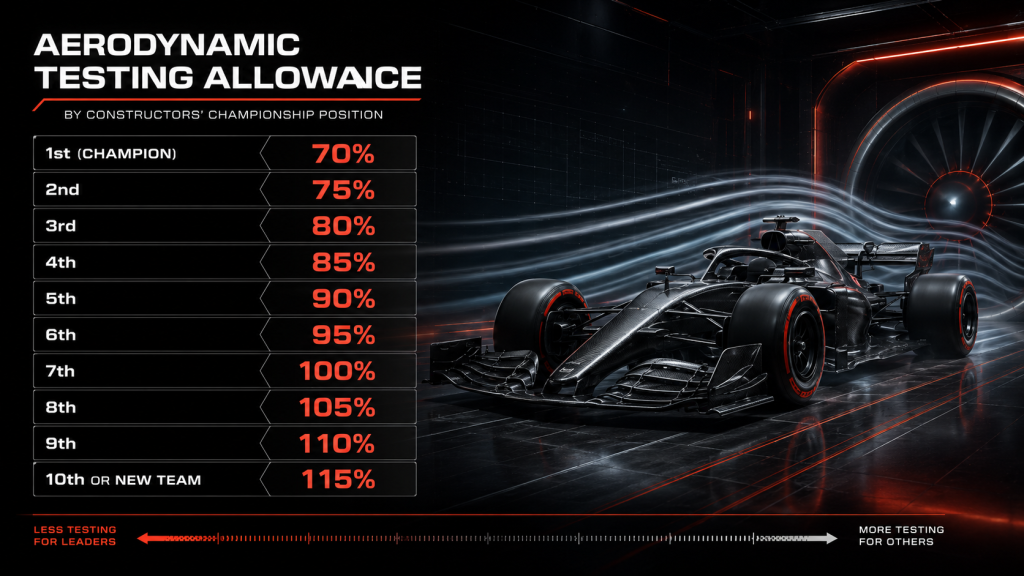
Under the FIA’s Aerodynamic Testing Restrictions, teams are given different wind-tunnel and CFD allowances according to their position in the Constructors’ Championship. The champion receives only 70% of the reference allowance, while teams classified tenth or lower—and new teams—receive 115%.
It is one of Formula 1’s most important competitive-balancing systems, yet it is often reduced to a simple statement that slower teams get “more wind-tunnel time”.
The full F1 wind tunnel rules are more detailed than that. They control how many runs a team can perform, how long the air can remain at testing speed, how long the facility may be occupied, how many new digital geometries can be tested and how much computing power may be used for CFD simulations.
What You Need To Know
- The 2026 Constructors’ Champion receives 70% of the reference aerodynamic-testing allowance.
- A team classified tenth or lower—and a new team—receives 115%.
- The allowance covers wind-tunnel runs, wind-on time, occupancy, CFD geometries and computing resources.
- Allocations are reassessed during the season, meaning a team’s development allowance can change for the second half of the year.
What are the F1 wind tunnel rules?
The official term is the Aerodynamic Testing Restrictions, usually shortened to ATR. The full system is set out in Article F4 of the FIA Formula 1 Operational Regulations, Section F.
The ATR controls the amount of restricted aerodynamic development that an F1 team may conduct away from the circuit.
That primarily covers two areas:
- Restricted Wind Tunnel Testing, or RWTT.
- Restricted Computational Fluid Dynamics simulations, or RCFDs.
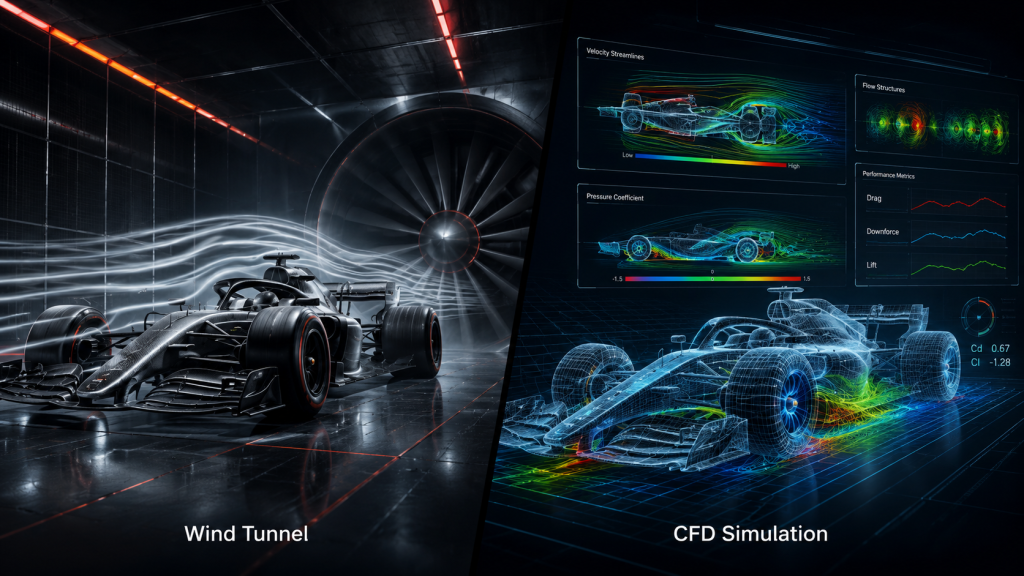
Wind-tunnel testing uses a physical scale model of the car inside a controlled airflow. Sensors allow engineers to study aerodynamic forces, pressures and airflow behaviour.
CFD uses computer simulations to model how air moves around the car. It allows engineers to test ideas digitally before deciding whether to manufacture parts or place a design in the wind tunnel.
Teams need both methods. CFD can process a huge range of ideas, while the wind tunnel provides physical data that can help confirm whether those simulations are accurate.
The FIA therefore restricts both rather than limiting only physical wind-tunnel testing.
How the 2026 aerodynamic-testing allowance works
The FIA begins with a reference allowance equal to a coefficient of 100%.
For one Aerodynamic Testing Period, that reference allowance consists of:
| Development measure | Allowance at 100% |
|---|---|
| Restricted wind-tunnel runs | 320 |
| Wind-on time | 80 hours |
| Wind-tunnel occupancy | 400 hours |
| New CFD test geometries | 2,000 |
| CFD compute allowance | 6 MAUh |
Each team’s Constructors’ Championship position determines which percentage of those figures it receives.
The 100% position is seventh. Teams above seventh receive less than the reference allowance, while teams below seventh receive more.
2026 F1 wind tunnel allowance by championship position
| Constructors’ position | Coefficient | Wind-tunnel runs | Wind-on time | Occupancy | New CFD geometries | CFD compute |
|---|---|---|---|---|---|---|
| 1st | 70% | 224 | 56 hours | 280 hours | 1,400 | 4.2 MAUh |
| 2nd | 75% | 240 | 60 hours | 300 hours | 1,500 | 4.5 MAUh |
| 3rd | 80% | 256 | 64 hours | 320 hours | 1,600 | 4.8 MAUh |
| 4th | 85% | 272 | 68 hours | 340 hours | 1,700 | 5.1 MAUh |
| 5th | 90% | 288 | 72 hours | 360 hours | 1,800 | 5.4 MAUh |
| 6th | 95% | 304 | 76 hours | 380 hours | 1,900 | 5.7 MAUh |
| 7th | 100% | 320 | 80 hours | 400 hours | 2,000 | 6.0 MAUh |
| 8th | 105% | 336 | 84 hours | 420 hours | 2,100 | 6.3 MAUh |
| 9th | 110% | 352 | 88 hours | 440 hours | 2,200 | 6.6 MAUh |
| 10th or lower/new team | 115% | 368 | 92 hours | 460 hours | 2,300 | 6.9 MAUh |
These are allowances for one Aerodynamic Testing Period, not unrestricted annual totals.
The difference between first and the lowest category is substantial. A team receiving 115% can complete 144 more wind-tunnel runs in the same testing period than the champion. It also receives 36 additional wind-on hours and 900 more new CFD geometries.
Why does the champion receive less wind-tunnel time?
The intention is to create a development handicap based on performance.
A team that has produced the best car is assumed to begin from a stronger competitive position. Giving that team the same aerodynamic-development allowance as every rival could make it easier for the advantage to continue indefinitely.
The sliding scale attempts to give teams further down the championship an opportunity to close the gap.
It does not directly slow the leading car. The champion is not required to remove performance or use inferior parts. Instead, the rules restrict how much aerodynamic research it may complete while developing future upgrades.
This is an important distinction.
The system rewards sporting success with championship points and commercial value, but that success also produces a development disadvantage.
What counts as a wind-tunnel run?
A restricted wind-tunnel run begins when the tunnel’s air speed rises above 5 metres per second.
The run ends when the air speed falls below 5 metres per second again.
Once the speed has risen above 5 metres per second, the test geometry must remain fixed and unmodified until the speed falls below 1 metre per second. Teams may make detailed changes to the model between runs, but not while the run is active.
This prevents a team from testing several independently adjustable aerodynamic configurations during what it attempts to record as one run.
A team could therefore use one run to test the car at several ride heights, steering angles or yaw conditions where permitted, but it cannot freely replace physical aerodynamic components while the tunnel remains active.
What is wind-on time?
Wind-on time is not the total time for which the tunnel is operating.
For the ATR calculation, wind-on time is accumulated when the tunnel’s air speed exceeds 15 metres per second during restricted testing.
The 100% allowance is 80 wind-on hours per testing period.
The champion’s 70% coefficient reduces that to 56 hours, while the maximum 115% category increases it to 92 hours.
This is why the number of runs does not tell the full story. Two teams could complete a similar number of runs but spend different amounts of time gathering data at meaningful testing speeds.
What is wind-tunnel occupancy?
Occupancy measures the broader period during which the facility is being used for restricted testing.
A team may conduct a maximum of two occupancy shifts during a calendar day. The rules define when each shift begins and ends according to the tunnel’s air speed and the team’s declared stopping time.
Occupancy restrictions matter because preparation, configuration changes and test operations can consume significant facility time even when the tunnel is not above the 15-metre-per-second wind-on threshold.
At the 100% coefficient, a team receives 400 occupancy hours per testing period.
How large can an F1 wind-tunnel model be?
Restricted testing may not use a model larger than 60% of the full-size car.
The relative air speed may not exceed 50 metres per second, which is approximately 180 kilometres per hour. The FIA also restricts how quickly the tunnel speed may change during the acceleration and deceleration phases of a run.
A 60% model does not mean that every aerodynamic effect behaves exactly as it would on the real car.
Teams need to account for scale effects and then establish a reliable relationship between three sources of information:
- CFD simulations.
- Wind-tunnel measurements.
- Data recorded by the real car at the circuit.
This relationship is normally described as correlation.
A team can have an advanced wind tunnel and a large testing allowance, but still struggle if its simulation and tunnel results do not accurately predict how the full-size car behaves on track.
Can a team use more than one wind tunnel?
Each team may nominate only one wind tunnel for restricted testing during a 12-month period.
The facility must be declared to the FIA, including its location, identity and the scale of the model that will be used.
A team normally cannot nominate another tunnel for at least 12 months. The FIA may consider an earlier or temporary change if the nominated facility suffers a long-term failure or when a team is evaluating an alternative tunnel.
Testing performed by an associate, contractor or outside organisation for the benefit of a team must still take place in that team’s nominated wind tunnel.
This prevents teams from avoiding the restrictions by moving development work to a partner company or external engineering supplier.
CFD is also restricted
Wind tunnels receive most of the attention, but CFD is equally important to modern F1 development.
The rules restrict both the number of new three-dimensional aerodynamic test geometries and the amount of computing resource used to solve the simulations.
The reference allowance permits 2,000 new Restricted Aerodynamic Test Geometries during one testing period.
The champion receives 1,400, while the maximum category receives 2,300.
The computing allowance is measured in Mega Allocation Unit hours, or MAUh.
In simplified terms, the FIA calculation considers the number of physical CPU cores used, how long the solver runs and the processing frequency achieved during the calculation.
The team must declare its computing resources to the FIA. The specification used must also be available on a non-exclusive basis to all teams, preventing a team from relying on inaccessible bespoke hardware as a hidden competitive advantage.
When do F1 wind tunnel allowances change?
There are six Aerodynamic Testing Periods during the year.
For the first three periods, a team’s coefficient is determined by its final position in the previous season’s Constructors’ Championship.
For the final three periods, the coefficient is based on the current championship order at the end of the last day of the third testing period.
This effectively creates an in-season reset.
A team that starts the year strongly may lose some aerodynamic-testing capacity for the second half of the season. A team that struggles may receive a larger allowance.
The effect creates an interesting strategic tension.
Improving immediately can reduce the development allowance available later. Remaining lower in the standings provides more testing, but it also means losing points, prestige, sponsor exposure and potentially championship-related income.
No team will deliberately choose to be slow simply for additional wind-tunnel time, but the reset can influence how quickly rivals are able to respond during the second half of the season.
What happens when the championship order changes after the reset?
Results can sometimes be revised after an event because of exclusions, appeals or later decisions.
Where that changes the championship order used to calculate the ATR coefficients, the FIA can require teams to adjust their testing from the beginning of the following period.
The FIA may also decide how any previous overuse or underuse should be absorbed before the end of the year.
If a coefficient changes after an Aerodynamic Testing Period has already begun, the revised limits can be applied proportionally to the time remaining.
This means the public percentage table provides the foundation, but a team’s exact internal allowance can be affected by timing, revised results and FIA-approved adjustments.
How does the FIA monitor wind-tunnel testing?
Teams must report their wind-tunnel and CFD activity to the FIA within 14 days of the end of each testing period.
Wind-tunnel runs must also be recorded using colour digital images that show the complete model. The files must carry a unique timestamp accurate to at least one second.
The images must be clear enough for the FIA to verify details such as whether the front and rear wings were fitted during the run.
CFD information is also retained for auditing. Teams must preserve meshes, simulation information, boundary conditions and other records that allow the FIA to trace the geometries and solutions used.
The FIA can arrange independent benchmarking inspections of teams’ wind-tunnel and CFD activities.
The ATR is therefore not based on teams simply declaring a total at the end of the season. It involves nominated facilities, reporting requirements, retained data, timestamped evidence and potential inspections.
What happens if a team exceeds its allowance?
Exceeding an ATR limit carries a particularly aggressive correction.
The FIA regulations state that the limits available in later testing periods will be reduced by at least ten times the amount exceeded. The FIA retains discretion over which later period—or periods—the reduction is applied to, and further action may also be taken.
The regulations provide a clear example.
A team that completes 325 wind-tunnel runs against an allowance of 320 has exceeded its limit by five runs.
Ten times that excess is 50.
If the full reduction were applied to the following period with the same starting allowance, the team would be limited to 270 runs.
That means a relatively small immediate overuse could produce a much larger future development loss.

Does more wind-tunnel time guarantee a faster car?
No.
The ATR controls the quantity of aerodynamic testing, not its quality.
A team with a larger allowance still needs:
- A wind tunnel that produces reliable data.
- Accurate CFD models.
- Strong correlation with the real car.
- Engineers who identify productive development directions.
- Manufacturing capacity to produce upgrades.
- Enough cost-cap room to design and build those parts.
- Track time to understand whether an upgrade works.
A badly directed programme can use hundreds of runs without finding meaningful performance.
A leading team may also achieve more from one run because its tools, processes and understanding of the car are more mature.
This is why the ATR should be viewed as an opportunity rather than a guaranteed performance equaliser.
Why the F1 wind tunnel rules matter during the season
Aerodynamic-testing allowances connect the current championship with the next phase of car development.
When a team rises or falls in the standings, the consequence is not limited to points. Its position can change how much wind-tunnel and CFD work it is allowed to complete after the in-season reset.
The system becomes particularly important during a major regulatory change, when teams must explore an unfamiliar aerodynamic concept. Formula 1 has published a separate guide to the 2026 aerodynamic regulations.
Teams may need to divide their resources between upgrading the current car and developing the following season’s design. A larger allowance gives a team more opportunities to evaluate concepts, but its cost cap, staffing, facilities and technical direction still determine whether that opportunity becomes lap time.
Try the On A Flying Lap ATR calculator
The On A Flying Lap Aerodynamic Testing Allowance Calculator lets readers compare two championship positions directly.
It shows the difference in:
- Wind-tunnel runs.
- Wind-on hours.
- Occupancy hours.
- New CFD geometries.
- CFD computing allowance.
It also includes an illustrative overuse calculator showing the minimum ten-times reduction described in the regulations.
Suggested placement: Embed the calculator immediately below the main allowance table or before the section explaining why additional testing does not guarantee better performance.
The big picture
Formula 1’s aerodynamic restrictions are designed to make success more difficult to sustain indefinitely while giving teams further down the order a better chance to recover.
The champion still begins with the advantage of having built the fastest package. What it loses is part of its capacity to investigate the next one.
That does not guarantee a compressed field, and it does not make the lowest-ranked team an automatic future contender. However, it ensures that every position in the Constructors’ Championship influences more than prize money and pride.
It also influences how much aerodynamic work a team is permitted to do next.
The next time a team suddenly begins producing effective upgrades—or appears unable to respond to a rival—it is worth looking beyond the parts visible on the car.
Its position in the championship may also be shaping what is happening inside the wind tunnel.
About The Author

Covering Formula 1 news, race analysis, driver stories and the bigger talking points around the sport.
Latest F1 News