The New Terms You Need to Know for Formula 1’s 2026 Changes
Follow 2026 Season UpdatesFollow updates
A New Era for Formula 1 in 2026
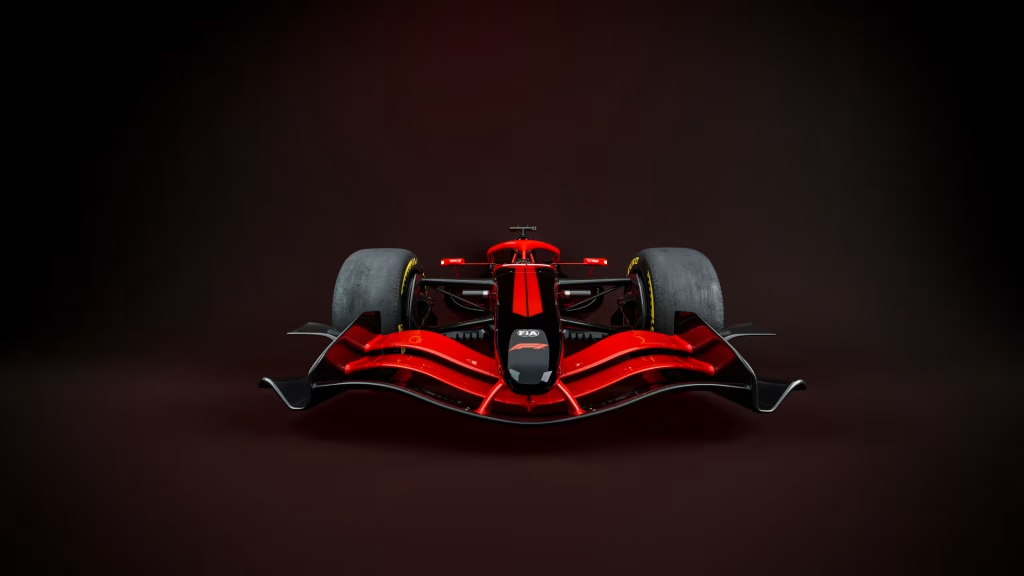
Formula 1 is preparing for one of its biggest technical resets in recent history when the 2026 regulations arrive. With sweeping changes to both aerodynamics and power units, the sport is also introducing a fresh set of terminology that fans will hear race after race.
If phrases like Boost Button, Overtake Mode or Active Aero sound confusing right now, don’t worry — here’s a clear and simple guide to the key new terms that will define the next era of Formula 1.
Boost Button
From 2026, the familiar energy deployment button used by drivers will officially be known as the Boost Button.
When pressed, it changes the power unit’s output to either:
- Return the car to maximum available power, or
- Switch to a team-configured power profile.
The Boost Button gives drivers flexibility. They can:
- Use all the boost at once to attack or defend
- Spread it across the lap depending on strategy
The key limitation? Energy availability. Drivers must manage their battery charge carefully if they want to deploy boost at the right moment.
Overtake Mode
Overtake Mode is an entirely new feature introduced to encourage closer racing and improve overtaking.
Here’s how it works:
- It can only be activated if a driver is within one second of the car ahead at a designated detection point (usually the final corner).
- Once triggered, it allows the car to recharge an additional 0.5 megajoules of energy.
- This unlocks a higher electrical power output on the following lap.
Overtake Mode is expected to be most effective on circuits with long straights, where the extra sustained speed can make a meaningful difference in closing the gap.
Recharge
Recharge refers to how cars recover energy to charge their batteries — and in 2026, this process becomes even more sophisticated.
Energy can be harvested through:
- Braking
- Partial throttle
- Lifting off the throttle (often called lift and coast)
- Super clipping, where energy harvesting occurs at the end of a straight while still at full throttle
Most Recharge behavior will be automated, controlled by ECU-managed maps and targets. Drivers will have direct control only over lift-off regeneration, where lifting early allows additional energy recovery.
However, there’s a trade-off:
- Lift-off regeneration disables Active Aero
- Super clipping keeps Active Aero engaged since the driver remains flat-out
Active Aero
One of the biggest visual and technical changes for 2026 is the introduction of Active Aerodynamics on both the front and rear wings.
For the first time:
- Wing angles will change dynamically depending on where the car is on track
- In corners, wings stay closed to maximize downforce
- On straights, wings move to an open, low-drag position to boost top speed
Rear wings can be opened in multiple designated zones per circuit — more than today’s DRS zones — and crucially, drivers won’t need to be within one second of another car to activate them.
Drivers will manually open the wings, just like DRS today. The system will:
- Automatically close under braking or throttle lift
- Automatically deactivate after a defined distance in certain zones to prevent unsafe cornering with the wings open
Why These Changes Matter
Together, these new systems are designed to:
- Increase strategic complexity
- Improve overtaking opportunities
- Make energy management more visible and impactful
While the terminology may sound complex now, it will quickly become second nature as the 2026 season unfolds.
Final Thoughts
Formula 1’s 2026 regulations aren’t just about new cars and engines — they represent a fundamental shift in how drivers race, attack and defend. Understanding these new terms will help fans better follow the on-track action as the sport enters its next chapter.
Stay tuned to On A Flying Lap for more deep dives as the 2026 era comes into focus.
You can also watch an explanation of these changes on Formula 1’s official YouTube Channel : https://youtu.be/GaDFJr5wSz0?si=SlGWhwB-_Otg6A4M
About The Author

Covering Formula 1 news, race analysis, driver stories and the bigger talking points around the sport.
Latest F1 News