What Is an Overcut in Formula 1? F1 Strategy Explained
Follow F1 Strategy UpdatesFollow updates
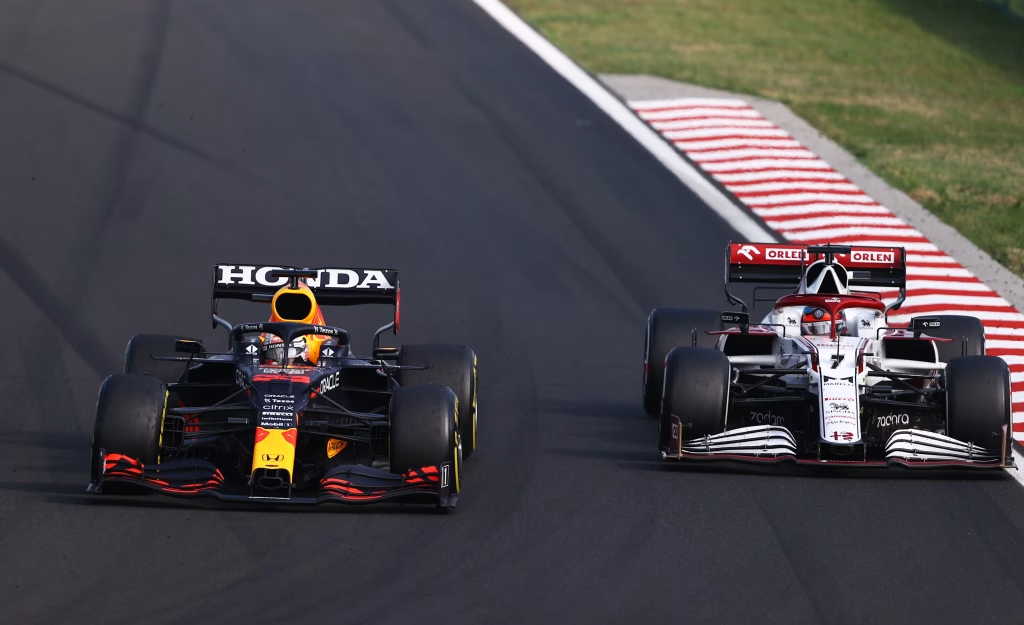
The overcut in Formula 1 is the quieter cousin of the undercut.
It does not always get the same attention, but when it works, it can be just as effective.
Instead of pitting early to attack, a driver stays out longer, keeps pushing on older tyres, and tries to gain enough time before making their own pit stop.
It sounds risky, because old tyres are usually slower. But in the right conditions, the overcut can be a smart way to steal track position.
What is an overcut in Formula 1?
An overcut happens when a driver stays out after a rival has already pitted.
The goal is to use clean air, strong pace, or tyre warm-up differences to gain time before making a pit stop.
Formula 1 explains the overcut as passing a rival by staying out after they pit and being faster on the old-tyre in-lap than the rival is on the new-tyre out-lap. This can happen when the new tyres do not come up to temperature quickly enough.
So while the undercut is about fresh-tyre attack, the overcut is about patience and timing.
Why does the overcut work?
The overcut works when the driver staying out can keep strong pace on older tyres.
That usually depends on a few things:
- The tyres must not be falling away too badly.
- The driver needs clean air.
- The rival who pitted must not gain immediately on fresh tyres.
- The new tyre compound may need time to warm up.
If the driver who stays out can produce a fast in-lap, they may rejoin ahead after their stop.
That is the overcut.
Why is the overcut harder than the undercut?
In modern F1, the undercut is often more common because fresh tyres usually give an immediate pace advantage.
The overcut is more difficult because it asks a driver to stay fast on older tyres while a rival has already stopped for new ones.
That can be dangerous if the tyres suddenly drop off.
One slow lap can ruin the entire strategy.
This is why teams are careful with overcuts. They need confidence that the driver has enough tyre life, enough pace, and enough clear track to make it work.
When does an overcut make sense?
An overcut can make sense on tracks where overtaking is difficult and track position is extremely valuable.
It can also work when tyre warm-up is difficult. If the rival pits and struggles on cold tyres, the driver staying out may have a chance to gain time.
Cooler conditions can also help. If tyres are not overheating, older tyres may remain competitive for longer.
Another key factor is traffic. If the rival pits into traffic and loses time, the driver staying out may take advantage.
That is why strategy is never only about tyre age. It is also about where the car will rejoin after the stop.
The risk of staying out too long
The biggest danger with the overcut is missing the window.
If the old tyres lose performance, the driver can start bleeding lap time.
If the team waits too long, the rival on fresh tyres may gain too much time.
If a safety car comes out at the wrong moment, the strategy can also be turned upside down.
The overcut is all about timing. Stay out long enough to gain, but not so long that the tyre performance disappears.
Undercut vs overcut: what is the difference?
The undercut is aggressive. Pit first, attack immediately, and try to jump the rival.
The overcut is patient. Stay out, keep the pace up, and try to gain before stopping later.
Both strategies are about the same thing: gaining track position through the pit stop cycle.
But they work in different ways.
The undercut depends on new tyre performance.
The overcut depends on old tyre performance, clean air, and the rival’s slow out-lap.
Why fans should watch for it
The overcut is easy to miss because the decisive moments can happen before the pit stop.
When a rival pits, watch the driver who stays out.
- Are they still setting strong lap times?
- Are they in clean air?
- Is the car on fresh tyres struggling to warm up?
- Is the gap moving in the right direction?
If the answer is yes, an overcut might be on.
It is one of the strategy moves that rewards patience, tyre management, and confidence from the pit wall.
In a sport where everyone talks about undercuts, the overcut is a reminder that sometimes the best move is not to react immediately.
Sometimes, the move is to stay out and make the other team nervous.
About The Author

Covering Formula 1 news, race analysis, driver stories and the bigger talking points around the sport.
Latest F1 News