How F1 Grid Penalties Work: Formula 1 Rules Explained
Follow F1 Penalties UpdatesFollow updates
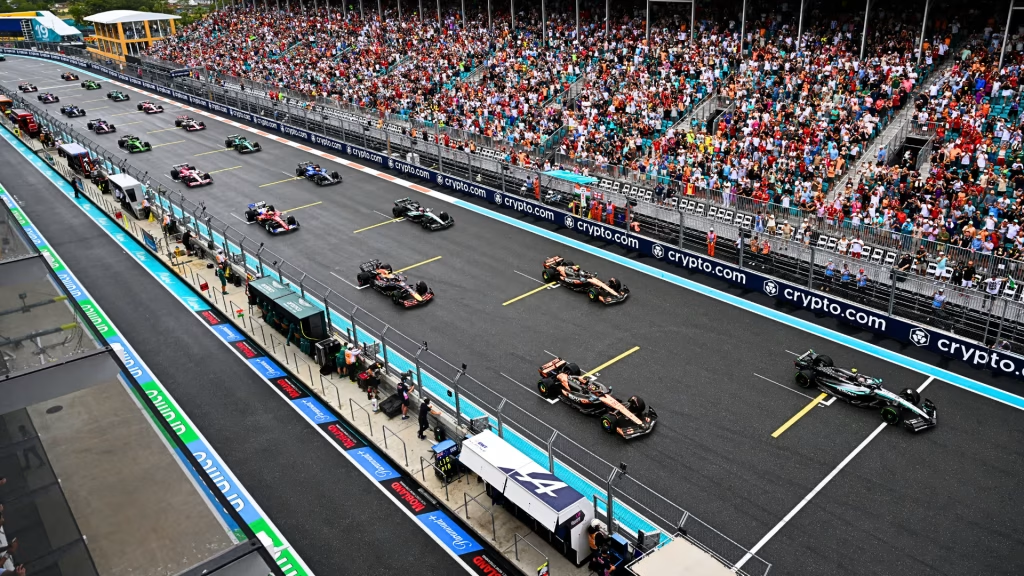
F1 grid penalties can turn a strong qualifying result into a frustrating race day.
A driver might qualify near the front, only to start several places lower. Another might take a new engine component and accept a penalty before the weekend even begins.
For fans, grid penalties can sometimes feel confusing. The driver sets one lap time, the provisional order says one thing, and then the final grid looks different.
So how do F1 grid penalties actually work?
What are F1 grid penalties?
F1 grid penalties are punishments that move a driver down the starting grid.
Instead of starting where they qualified, the driver drops a certain number of places. For example, a five-place grid penalty means the driver is moved five positions lower than their qualifying result, depending on how other penalties are applied.
Formula 1’s own beginner guide explains that a grid penalty forces a driver to drop positions at the next race weekend they participate in, and that these penalties can come from sporting offences or from exceeding allowed engine component allocations.
In simple terms: qualify well, take a penalty, start lower.
Why do drivers get grid penalties?
Drivers can receive grid penalties for different reasons.
Some are sporting penalties. These can include incidents such as impeding another driver in qualifying, causing a collision, ignoring instructions, or other rule breaches.
Others are technical or component-related. Formula 1 cars are limited in how many certain power unit components they can use across a season. If a team needs to use more than the allowed number, the driver can receive a grid penalty.
This is why teams sometimes take a new engine at a circuit where overtaking is easier. If they know a penalty is coming, they may choose a track where recovery is more realistic.
How are grid penalties applied?
The FIA sporting regulations explain that, for incidents during qualifying-style sessions, stewards can delete lap times or drop a driver a number of grid positions. Grid penalties are normally served in the Race, unless the infringement happened in Sprint Qualifying, in which case it applies to the Sprint grid.
After qualifying, the FIA works through the penalties and publishes the provisional and final starting grids.
This is why the order immediately after qualifying is not always the order the race starts in.
If one driver has a penalty, it may be simple. But if several drivers have penalties, the final grid can become more complicated.
Why does the final grid sometimes look confusing?
The final grid can look strange because penalties do not always mean every driver simply moves down in a straight line.
If multiple drivers are penalised, the FIA has to apply the rules in a specific order. The 2026 sporting regulations include a procedure where penalised and unpenalised drivers are allocated grid positions, with larger penalties and back-of-grid cases handled differently.
That is why fans sometimes see a driver with a five-place penalty not ending up exactly five visible positions lower once every other penalty has been applied.
It is not always intuitive, but the basic idea is this: penalties are added to the qualifying order, then the final grid is rebuilt according to the regulations.
Are grid penalties always fair?
This is where F1 fans often disagree.
A grid penalty for impeding in qualifying can feel straightforward if one driver clearly ruined another driver’s lap.
But engine penalties are more controversial. Sometimes a driver suffers because the team needs to change components, even if the driver personally did nothing wrong.
That is part of Formula 1. The car, team, driver, reliability, and rules are all connected.
A brilliant driver can still be pushed down the grid by a reliability problem. A team can also choose to take a penalty strategically, accepting short-term pain for better performance later in the season.
How grid penalties affect race strategy
Grid penalties do not only change the starting position. They change the entire race plan.
A driver starting lower than expected may need a more aggressive strategy. The team might choose a different tyre compound, pit earlier, or try to use clear air.
The race can also become riskier. Starting in the midfield means more traffic, more dirty air, and a higher chance of first-lap trouble.
That is why grid penalties can be so damaging. Losing positions before the race even starts changes everything.
Why fans should care
F1 grid penalties are more than admin.
They can change qualifying, strategy, and the race result.
A driver who qualifies on the front row might suddenly start in the midfield. A rival may gain free positions. A team may decide to sacrifice one weekend to strengthen the rest of the season.
So when a driver receives a grid penalty, do not only ask how many places they lose.
Ask where they will start, what tyres they might use, how easy overtaking is at that circuit, and whether the penalty changes the bigger championship picture.
That is where the real story begins.
About The Author

Covering Formula 1 news, race analysis, driver stories and the bigger talking points around the sport.
Latest F1 News